
Stainless Steel Diaphragm Coupling: Redefining Reliability in Harsh Power Transmission
In the world of industrial drive systems, failure is not an event — it’s a chain reaction.
A corroded bolt, a fatigued diaphragm, or a misaligned hub can bring an entire production line to a halt.
That’s why the stainless steel diaphragm coupling is more than a mechanical connector — it’s an engineered safeguard against uncertainty.
Built for long service life under heat, torque, and chemical exposure, Dingjian’s couplings ensure the kind of reliability that only material science and precision engineering combined can achieve.
How Stainless Steel Changes the Game in Torque Transfer
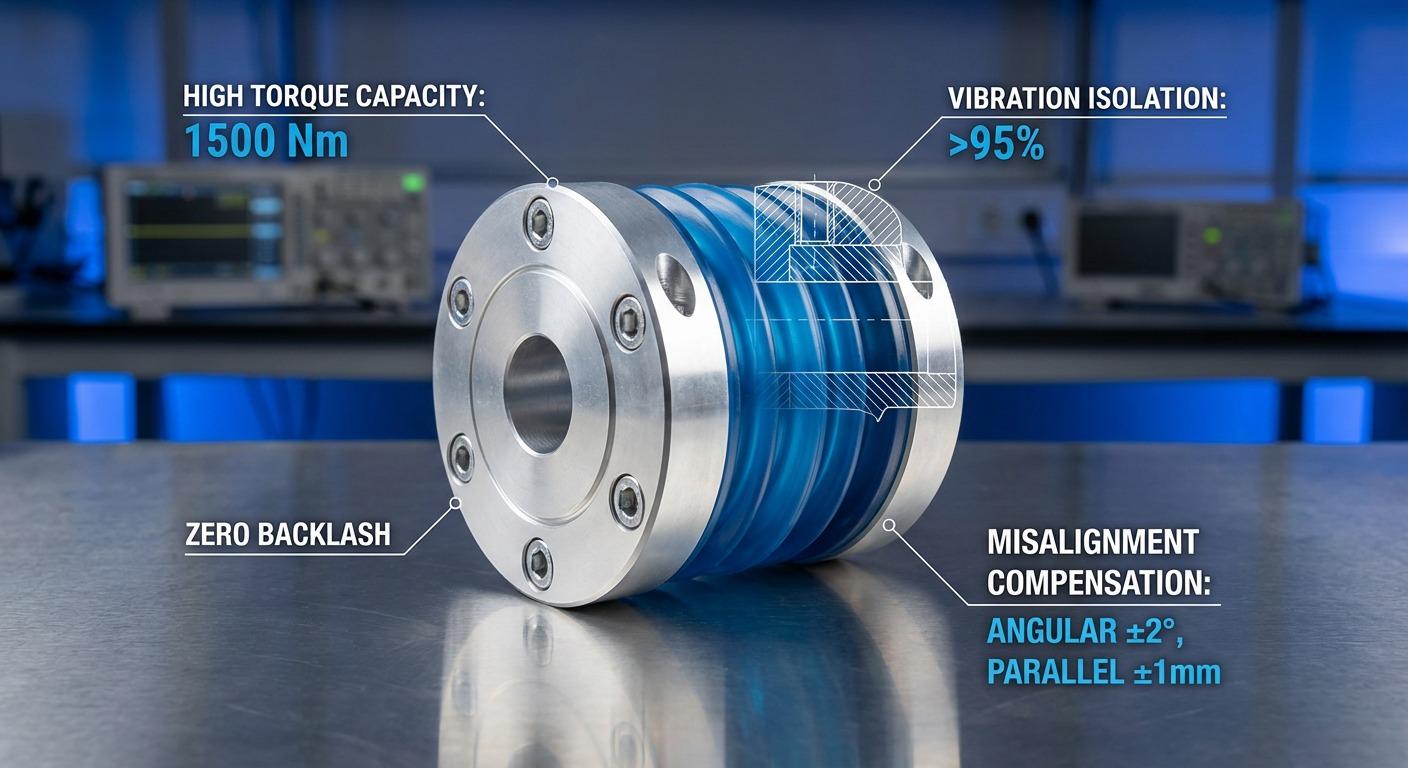
In essence, a diaphragm coupling is a flexible disc that transmits torque while absorbing shaft misalignment.
But when constructed from stainless steel, the behavior of that disc changes fundamentally.
At the microscopic level, stainless steel’s austenitic crystal structure gives it superior ductility and fatigue endurance, allowing controlled flexure under repeated torque cycles.
Its chromium-rich surface layer naturally resists oxidation and chemical attack — a self-healing passive film that replaces the need for coating or maintenance.
The outcome?
A coupling that maintains both mechanical rigidity and environmental immunity, even when exposed to high temperatures, saline atmospheres, or aggressive chemicals.
Beyond the Basics: Engineering a Better Stainless Steel Diaphragm
Dingjian’s engineering process is not limited to material selection — it’s a multi-stage integration of stress modeling, heat treatment, and micro-polishing.
1. Controlled Metal Grain Orientation
During forging and annealing, metal grain flow is aligned with torque paths, reducing microscopic crack initiation.
2. FEA-Driven Thickness Optimization
Finite Element Analysis identifies flexure points to distribute stress evenly across the diaphragm surface.
3. Dual-Surface Mirror Polishing
Removes machining marks and eliminates stress risers that often trigger early fatigue failure.
4. Multi-Disc Modular Design
For higher torque or misalignment tolerance, Dingjian’s multi-diaphragm configurations balance flexibility and stiffness perfectly.
Together, these processes extend the coupling’s life up to five times longer than conventional alloy types.
Comparing Stainless Steel Couplings Across Industry Classes
| Feature | Standard Alloy Coupling | Stainless Steel Diaphragm Coupling | Titanium Hybrid (Optional) |
|---|---|---|---|
| Torque Range | Medium | High & consistent | High, lightweight |
| Corrosion Resistance | Needs coating | Naturally passive layer | Excellent, costlier |
| Operating Temp. | ≤150°C | ≤300°C continuous | ≤400°C |
| Fatigue Life | Moderate | 20,000–40,000 hours | 50,000+ hours |
| Maintenance | Lubrication required | None | None |
| Cost-Performance Ratio | Balanced | Optimal | Premium niche |
This isn’t just about endurance — it’s about efficiency under unpredictability.
In marine propulsion or gas compression, when operating environments swing between 40°C and 250°C, stainless diaphragms maintain both elastic modulus and torque fidelity.
Precision Under Pressure
Case 1 – Petrochemical Compressors (Indonesia)
A refinery reported frequent grid coupling failures due to corrosive vapor exposure.
After retrofitting with Dingjian stainless diaphragm couplings, maintenance intervals extended from 6 months to 3 years — a 600% lifecycle improvement.
Case 2 – Offshore Generator Systems (North Sea)
Salt corrosion and vibration caused shaft alignment issues.
Dingjian introduced a double-diaphragm design with 316L discs, achieving stable operation under 120 kNm torque for over 30,000 running hours.
Case 3 – Semiconductor Fabrication Tools
In cleanroom environments, any lubricant or debris is unacceptable.
The fully dry-operation stainless coupling eliminated contamination risk while maintaining sub-micron concentricity.
Each case demonstrates one truth: stainless flexibility is not compromise — it’s control.
Selection Guide: Designing for Performance and Longevity
| Parameter | Importance | Dingjian Recommendation |
|---|---|---|
| Torque Level | Continuous torque + 25% overload | Multi-disc 42CrMo/316L hybrid |
| Temperature Variation | High fluctuation | Fully stainless diaphragm with thermal balancing |
| Corrosive Environment | Acids, salt, vapor | 316L or duplex stainless |
| Space Constraints | Compact machinery | Single-diaphragm short-hub type |
| Service Interval | Unattended operation | Maintenance-free design |
Tip: For rotating drives over 10,000 RPM, specify Dingjian’s dynamic balancing certification (ISO G2.5) to avoid micro-vibration resonance.
Common Technical Questions
Q1: Why choose stainless steel over coated carbon steel?
Because coatings wear; stainless steel’s passive oxide layer continuously regenerates, ensuring corrosion resistance for decades.
Q2: Can stainless couplings handle torsional shock?
Yes. The diaphragm’s elastic deflection absorbs micro-load peaks, protecting motor bearings and seals.
Q3: What grade of stainless does Dingjian use?
Commonly 304, 316L, or duplex stainless for marine and petrochemical systems, depending on environment.
Q4: How does Dingjian verify fatigue life?
Through cyclic loading simulation — 10⁷ load cycles at rated torque under 200°C to ensure structural reliability.
The Future of Reliable Motion
Industrial drive systems are evolving — faster speeds, higher loads, and harsher conditions.
Yet the principles remain the same: alignment, balance, and endurance.
With stainless steel diaphragm couplings, Dingjian isn’t just delivering components; it’s redefining what “reliability” means in the mechanical world.
Precision machining, advanced metallurgy, and intelligent structural design combine to create couplings that last longer, perform cleaner, and protect better.
To explore custom solutions for your torque systems or request a design consultation, visit the official homepage or contact us via the contact page.