
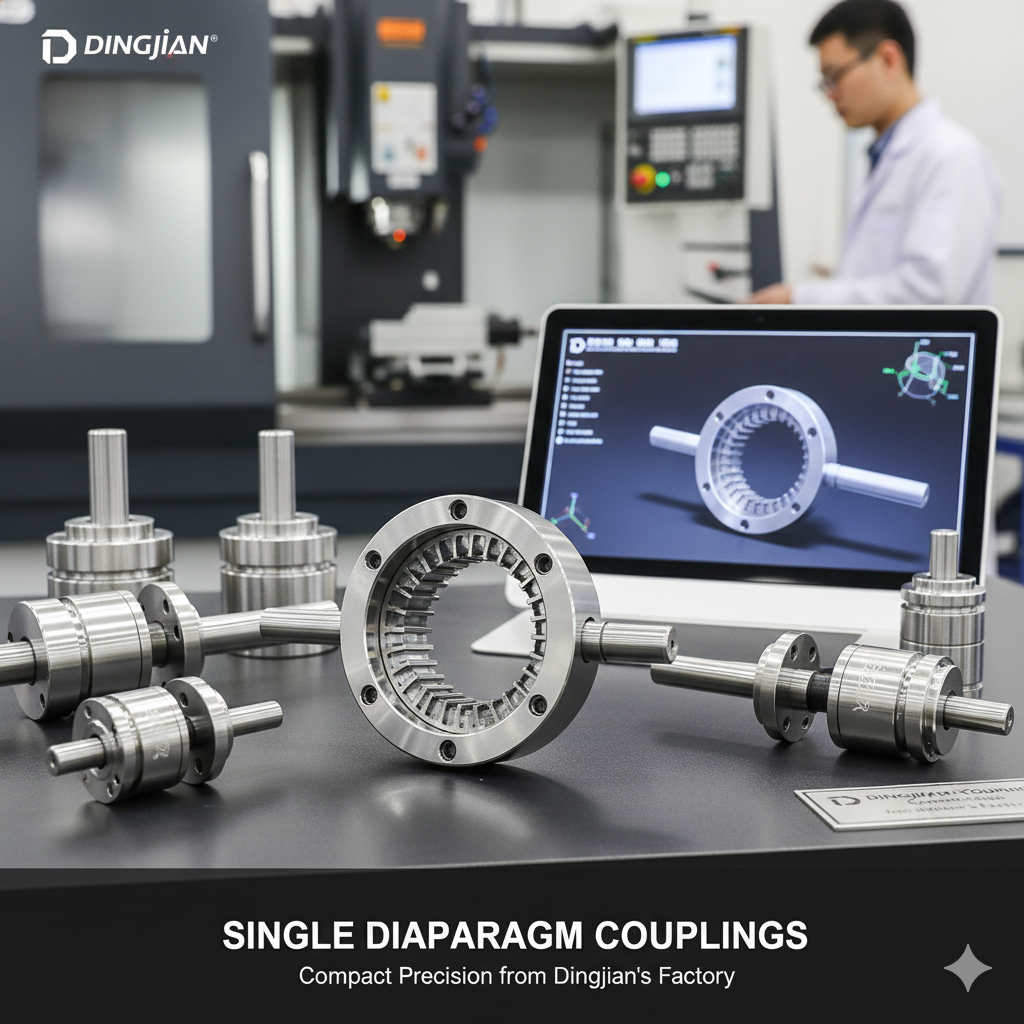
Single Diaphragm Couplings: Compact Precision from Dingjian’s Factory
In modern mechanical systems, efficiency often depends on what you can remove, not what you can add.
Where space is limited and rotational balance is non-negotiable, the single diaphragm coupling becomes an elegant solution.
Unlike bulky multi-disc assemblies, this compact configuration delivers precision torque transfer in minimal space — without compromising alignment flexibility.
At Dingjian, our factory has refined the art of single-disc coupling design — focusing on micro-alignment, fatigue control, and thermal balance — for high-speed industrial and automation systems that demand both lightness and strength.
The Mechanical Principle Behind Single-Disc Precision
A single diaphragm coupling transmits torque through a metallic flexible membrane that bends elastically under small misalignments.
Unlike grid or gear couplings, it does not rely on lubrication or mechanical clearance, which means no backlash, no wear, and no maintenance.
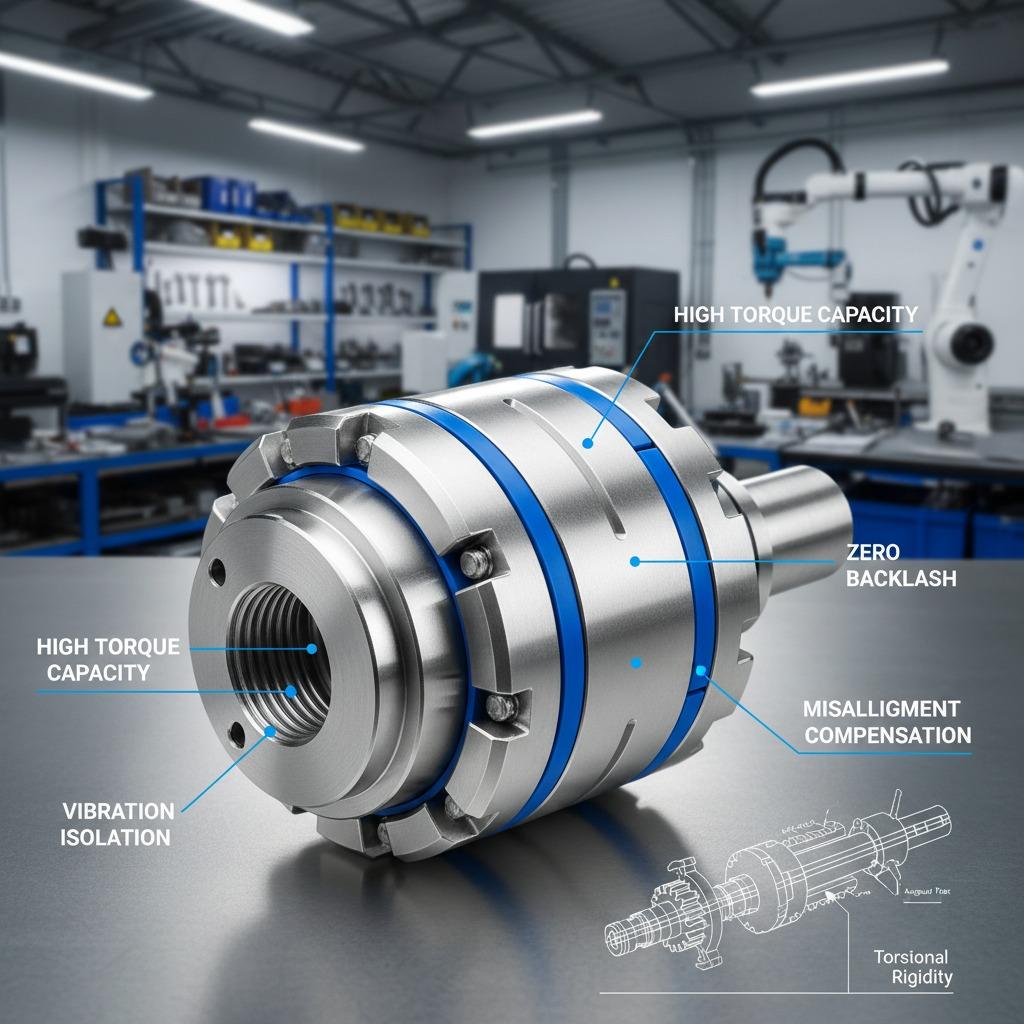
The core structure includes:
-
Two hubs clamped to each shaft end
-
One metallic diaphragm disc made of stainless or alloy steel
-
Bolt circle providing torque continuity and equal load distribution
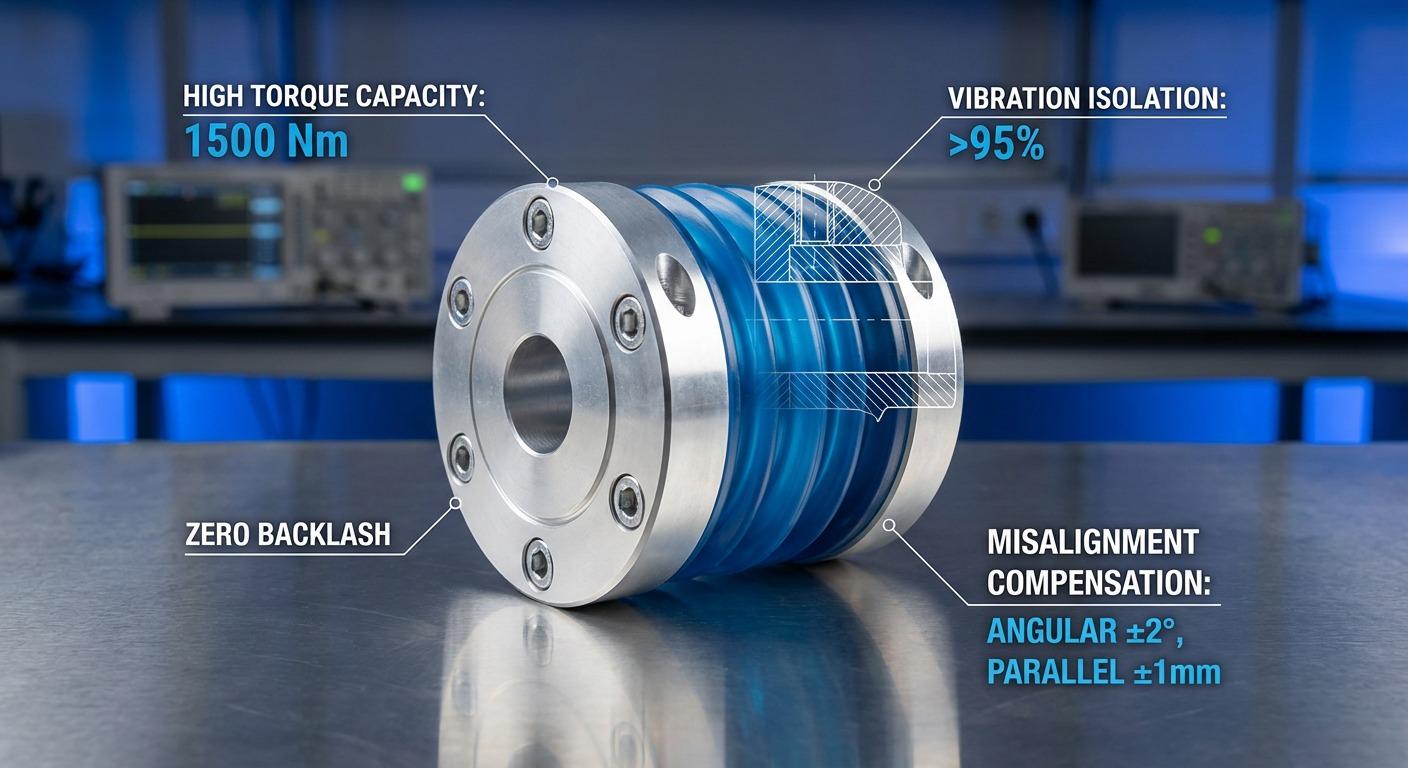
When torque is applied, the diaphragm flexes slightly while maintaining axial symmetry — allowing up to ±1° angular misalignment while ensuring continuous torque flow.
According to the ISO 14691:2016 standard for metallic flexible couplings, single-disc designs provide the highest torsional stiffness-to-weight ratio among all flexible coupling types, making them ideal for high-speed drives and servo applications.
From Design to Production: Inside Dingjian’s Manufacturing Process
Every coupling produced at Dingjian’s factory undergoes a precision-controlled workflow combining advanced machining and material science:
-
CNC Machining of Hubs – Each hub is cut within ±0.01 mm concentricity tolerance using multi-axis lathes.
-
Laser Profiling of Diaphragms – Ensures uniform stress distribution and symmetrical torque response.
-
Surface Polishing & Passivation – Eliminates microcracks and provides corrosion resistance.
-
Dynamic Balancing (ISO G2.5 Certified) – Each unit is individually balanced to eliminate torsional vibration.
-
Stress-Relief Heat Treatment – Removes residual stress and enhances fatigue strength by 25–30%.
These processes collectively ensure that Dingjian’s single diaphragm couplings achieve stable torque precision even at speeds above 10,000 RPM.
Comparison: Single vs. Double Diaphragm Couplings
| Parameter | Single Diaphragm Coupling | Double Diaphragm Coupling |
|---|---|---|
| Flexibility | Moderate (compact) | Higher (longer body) |
| Size & Weight | Lightweight | Larger footprint |
| Misalignment Compensation | ±1° angular | ±1.5° angular + axial |
| Stiffness | Higher | Slightly reduced |
| Typical Application | Servo drives, pumps | Compressors, turbines |
| Maintenance | None | None |
Single diaphragm couplings are best suited for precision servo systems and compact transmission assemblies, where high rotational accuracy outweighs large misalignment tolerance.
Applications: Compact Strength in Real-World Systems
1. Robotics & Automation Systems
High-speed robotic joints require zero-backlash motion and rapid acceleration. Dingjian’s single-disc couplings enable precise angular response in servo drives.
2. CNC and Milling Equipment
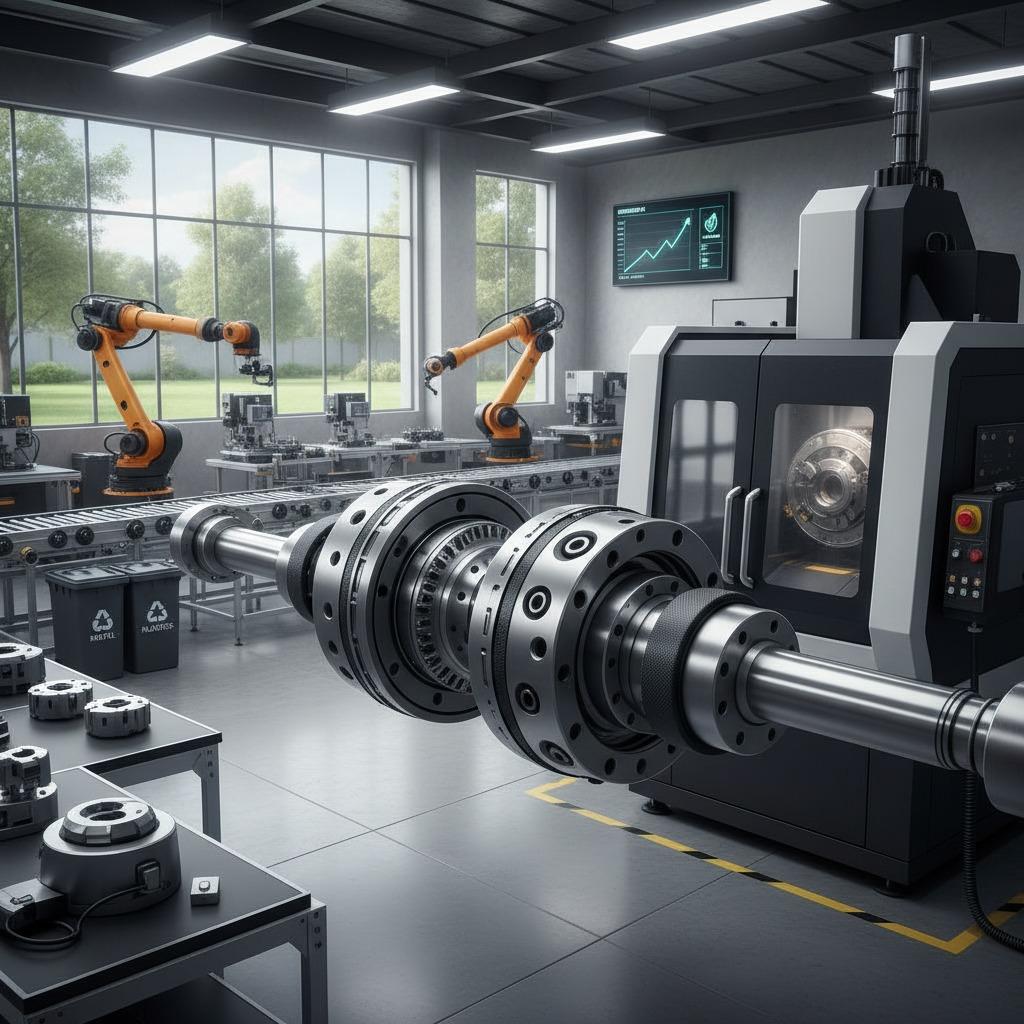
The high torsional stiffness ensures direct torque transmission between motor and ball screw — improving machining accuracy by up to 20%.
3. Pumps & Compressors
Compact couplings reduce vibration and simplify maintenance in rotary equipment.
4. Aerospace Simulation Units
Stainless single-disc couplings withstand vacuum and thermal variations while maintaining rotational stability.
Design Considerations: Matching Coupling Geometry to Use Case
| Design Factor | Importance | Dingjian’s Factory Recommendation |
|---|---|---|
| Torque Load | Define peak torque + 20% margin | 316L diaphragm, single disc |
| Speed Range | Higher RPM → tighter balance | Use G2.5 dynamic balance series |
| Alignment Tolerance | Slight misalignment only | Compact single-disc design |
| Environment | Corrosive or humid | Stainless material, sealed bolts |
| Space Limitations | Short axial length | Single-disc over multi-disc |
Practical Note:
For compact systems where weight and alignment precision matter — such as robotic actuators — the single diaphragm coupling achieves optimal power density-to-weight ratio, outperforming grid and gear couplings in both stiffness and responsiveness.
Common Questions About Single Diaphragm Couplings
Q1: What makes single diaphragm couplings ideal for servo systems?
Their torsional rigidity eliminates backlash, ensuring synchronous motion between motor and load.
Q2: Are they suitable for high-torque machinery?
Yes, up to moderate torque ranges. For extreme torque applications, Dingjian’s double-diaphragm series is recommended.
Q3: How is alignment ensured during installation?
Through precision-machined hubs and laser marking alignment guides.
Q4: What materials are commonly used?
Typically 304, 316L, or 42CrMo for the hubs, and stainless spring steel for the diaphragm.
Compact Design, Expansive Capability
A well-designed coupling should do more than connect — it should protect, stabilize, and optimize every motion cycle.
That’s exactly what Dingjian’s single diaphragm couplings deliver: compact form, long fatigue life, and exact torque transfer, built for today’s precision machinery.
For technical drawings, customization, or export consultation, please visit our homepage or contact us through the contact page.